
Posted by Mahé
on July 09, 2026

Table of Contents
- Plant-based hair dye: how does it really work?
- What is a coloring treatment like on a daily basis?
- Plant-based hair dye for white hair: results and limitations
- Frequently Asked Questions
Plant-based dyeing relies on specific mechanisms: which dyeing plants are involved, how does a plant-based hair dye act on the hair, and how to choose a shade suited to your base, your lengths, and the presence of white hair.
Plant-based hair dye: how does it really work?
When looking for a natural hair dye, you often want an effective solution that is also formulated to respect the hair fiber. This is precisely the principle of a natural plant-based hair dye: The formula acts around the hair fiber, respecting its structure without aggressive transformation.
Which plants naturally color the hair?
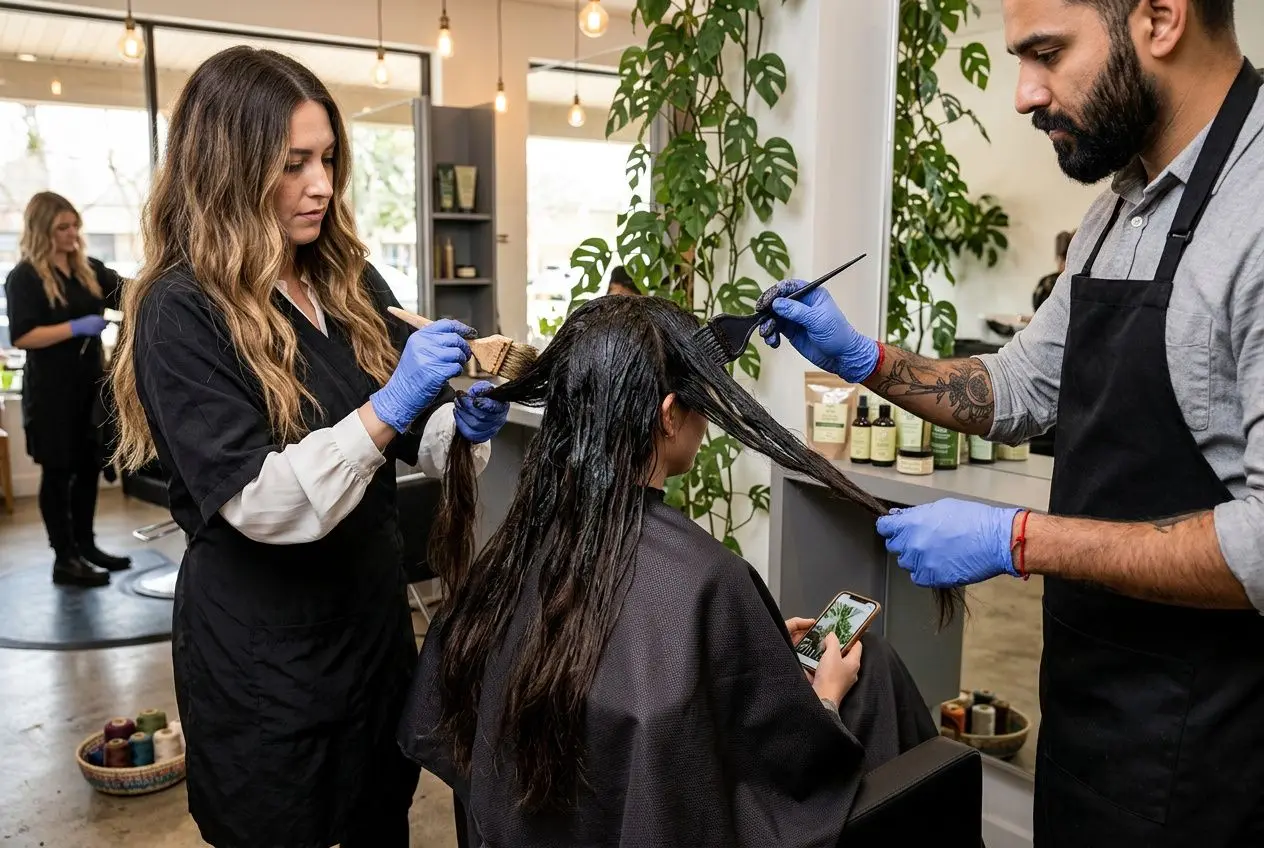
To understand the mechanism of plant dyeing, you must first examine the plants used. Each brings specific natural pigments that attach to the keratin and coat the fiber. The result does not change the hair from the inside: it covers it with a protective coloring veil.
- Henna (Lawsonia inermis): henna, also called lawsonia, releases lawsone. This pigment gives a tint ranging from copper to red, with variations depending on the origin of the plant.
- Indigo (Indigofera tinctoria): indigo brings darker tones. Combined with henna, it allows you to obtain a deep, even darker brown. However, it is not recommended alone on white hair.
- Amla (Phyllanthus emblica): renowned in Ayurvedic traditions, this plant helps enhance shine, cool down certain highlights, and support coloring mixtures.
Other botanical active ingredients complete these synergies. Madder supports warm shades, chamomile brightens light hair and blonde bases, while katam is sought for adding nuance and protecting the hair.
Plant-based vs. chemical hair dye: what are the differences?
The major difference lies in the mode of action. A plant-based or natural hair dye deposits color on the surface, while a chemical formula opens the hair to modify its internal pigments, often with ammonia or oxidizing agents. Here, the dyes deposit on the hair fiber and color after 1 hour. The shade gradually fades over time with washing, without penetrating the fiber.
This approach constitutes a gentle alternative, without compromising on shine, for those who want to cover or blend white hair while maintaining soft hair. The color gradually fades over washes, without a harsh root demarcation, while bringing more body and hold to the hair.
The MAHÉ natural formula, a protective gel texture
For over 45 years, MAHÉ has developed an engaged expertise around natural hair care up to 98%. The brand's natural plant hair dye stands out for its gel texture, designed to wrap the hair like a cream and immediately form a protective film.
Its formula notably combines Breton marine bamboo rich in silica, organic linseed oil rich in omega-3, and organic castor oil to nourish, soften, and reveal shine. Without ammonia, without hydrogen peroxide, without PPD or resorcinol, it offers a clear answer to those looking for a natural hair dye formulated with plants.
To prolong the result, MAHÉ natural hair care products support daily maintenance. A consistent way to preserve the shine of MAHÉ plant hair dye and continue to respect the hair fiber, wash after wash.
What is a coloring treatment like on a daily basis?
Doing your coloring treatment at home is simpler than we imagine, provided you follow a few clear guidelines. The gesture quickly becomes familiar. And above all, it allows you to take care of your hair as well as your health, without compromise between results, application comfort, and respect for the scalp.
Step-by-step application of the coloring treatment
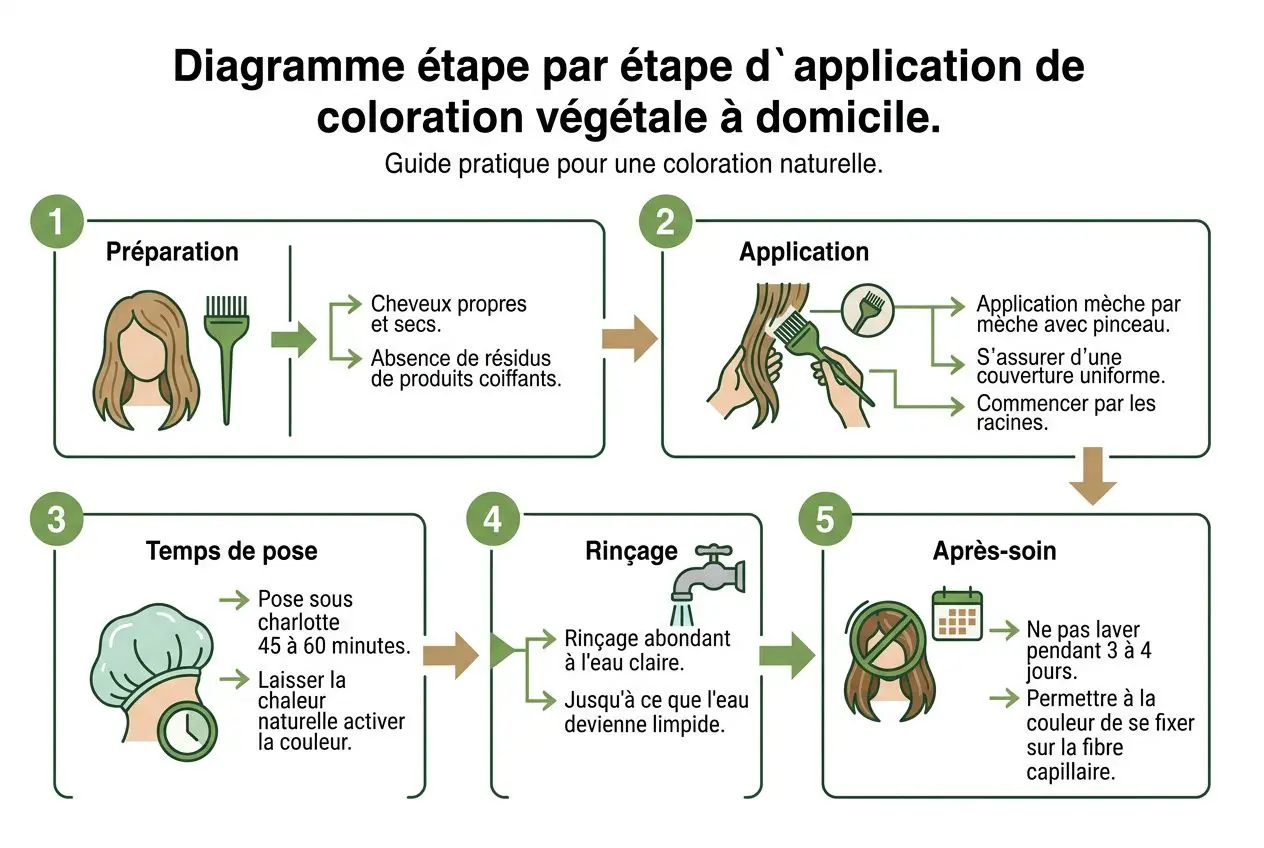
The gel formula, formulated with plants, is applied to clean and dry hair, section by section, starting from the back of the head and moving forward. It is applied up to the roots and the scalp using the provided brush. Each pack also contains gloves and a cap to allow you to perform your coloring treatment in good conditions.
The waiting time then varies from 45 to 60 minutes. After that, rinse abundantly until you obtain clear water. Then wait 3 to 4 days before washing the hair: this time is necessary for the pigments from the plants to fully oxidize and reveal the final shade. Regarding quantity, our bottles can be reused for 1 year after opening:
- 125 ml bottle: 2 to 3 applications on average
- 250ml bottle: 4 to 5 applications
Coloring treatment adapted to sensitive scalp
The botanical-based coloring treatment responds to a frequent reality: when the scalp is weakened, each application requires more vigilance. The solution proposed by MAHÉ is based on a natural formula, without resorcinol, without ammonia, without parabens, without PPD, and without hydrogen peroxide. A gentle alternative to respect the hair fiber and limit unnecessary aggressions.
For 47 years, MAHÉ has supported people allergic to chemical dyes, with an expert approach built on field experience. However, a sensitivity test remains essential 48 hours before first use. This coloring treatment is also contraindicated in case of a rash on the face, a history of allergy to hair dye, or before age 16.
Plant-based or natural hair dye for white hair, results and limitations
When white hair becomes more visible, many look for a gentler solution to color the hair without compromising the health of the hair. Plant-based or natural hair dye meets this expectation, provided you choose the right shade, use a quality product, and follow a suitable protocol.
This plant-based approach can offer real coverage of white hair, while bringing a natural highlight. But it also has its rules. Knowing them better means taking care of your hair as well as your health.
Plant-based or natural brown hair dye, what coverage of white hair?
MAHÉ plant hair dye for white hair covers up to 100% of white hair from the first application. When the proportion of white hair is high, you generally obtain a more homogeneous result with a sustained shade.
- Coverage up to 100%: from the first application, Mahé natural hair dye coats each hair, even on very white hair.
- Light brown or blonde: on light hair, the plants reveal a golden or copper highlight without altering the fiber.
- Hold of 4 to 6 weeks: on natural hair, the duration varies depending on porosity and washing frequency; on white hair, a touch-up every 3 weeks often remains useful.
To remember: a natural or plant-based hair dye does not lighten. It does not bleach either. For a consistent result, you must therefore choose a shade identical or darker than the starting color, from light brown to mahogany, passing through red or copper.
| Chosen shade | Recommended hair profile | Expected result |
| Dark brown | White hair > 25%, brown hair | Complete coverage, deep warm highlights |
| Light brown | Light brown hair, a few white hairs | Golden highlights, natural fading of white hairs |
| Golden blonde (chamomile) | Light hair, natural blonde | Luminous highlights, increased shine |
| Mahogany / red | Browns to dark browns wanting copper highlights | Copper intensification, sustained shine |
Plant-based care to prolong the shine of the highlight
Among the disadvantages often mentioned for this type of botanical care, gradual fading is one of the most common.
However, targeted maintenance allows you to prolong the shade. The camellia highlight shampoo helps revive a copper highlight on natural or colored hair, with hops, rosemary, and sage. It can be integrated into a routine completed by a volumizing mousse with hops and a smoothing maca treatment without rinsing, all without parabens.
Disadvantages and points of vigilance of plant-based or natural hair dye
However, it is not suitable for all situations. Certain limitations must be known to choose this plant-based solution without compromise and while respecting the hair fiber.
- No lightening possible: the plant powder cannot transform a dark base into blonde, nor catch up with the effects of a previous bleaching.
- On very highlighted or bleached hair: the dye is not recommended to avoid unwanted highlights.
- Quality of the composition: Check the absence of PPD and ammonia
Used methodically, the botanical-based dye covers white hair without altering the hair fiber, as confirmed by the results observed from the first application. For over 45 years, MAHÉ has been developing plant-based hair care products, available on mahefrance.com, in pharmacies, and in organic stores. To better understand the history of this practice, you can also consult this page on plant-based hair dye.
Frequently Asked Questions
Which plant can naturally color the hair?
To color the hair without compromise, several dyeing plants are recognized for their richness in natural pigments. Henna, from lawsonia, brings a copper to red highlight depending on the waiting time and the starting base. Indigo, meanwhile, allows you to obtain darker tones and is often combined with henna to go towards a deep brown.
Other plants complete this botanical palette: madder, chamomile, cinnamon, or even amla. In powder, these plant-based active ingredients can be integrated into a botanical preparation or a homemade plant-based preparation, provided you respect the hair fiber and the nature of each hair. The goal remains the same: to obtain a harmonious color thanks to plant pigments that deposit around the fiber.
Mahé keeps synthetic dyes specifically sourced for a ready-to-use product.
What are the disadvantages of plant-based hair dye?
This gentle alternative to chemical dyes nevertheless presents some limitations. It can neither lighten nor bleach: to color the hair, the chosen shade must remain equal or darker than the natural color. On very highlighted or heavily bleached hair, the result can also be less homogeneous.
Mahé hair dye ensures you a homogeneous result unlike plants which can give unwanted highlights and dry out the hair.
Its hold is generally 4 to 6 weeks, which is less than a permanent chemical hair dye. You must also remain vigilant about the quality of the powder used: some henna-based references can contain allergenic substances. A sensitivity test 48 hours before application therefore remains essential to take care of your hair as well as your health.
How to easily do your plant-based or natural hair dye at home?
Doing your plant-based hair dye at home can be simple when the formula is well thought out. With a ready-to-use formula like MAHÉ's, apply the gel texture to clean and dry hair, section by section, using the provided brush. For a plant-based hair dye, mix the powder and the water.
Then put on the cap and leave to work for 45 to 60 minutes. Rinse abundantly with clear water, then wait 3 to 4 days before the first shampoo to allow the natural pigments to fully reveal themselves.
